
Every leader carries a story about who they are. Not the story they tell at conferences or in performance reviews, the one they have never said aloud, the one assembled quietly over a lifetime from the sediment of experience: what success taught them, what failure taught them, what culture taught them, what childhood taught them. This story settles subconsciously. It does not announce itself. It simply becomes the lens through which every new experience is filtered, and through which almost all contradicting evidence is, just as quietly, discarded.
This is not a weakness. It is how the human mind works. Once a narrative takes its basic shape, confirmation bias becomes its maintenance crew, selecting information that confirms the story, dismissing information that threatens it, making the identity feel more stable than it actually is. The leader does not decide to do this. The mechanism is older than the decision. It runs beneath awareness, beneath intention, beneath even the most sincere commitment to honest self-examination.
And for a long time, often for years, sometimes for decades, the narrative serves the leader extraordinarily well. The story they have constructed about who they are is, in every environment they occupy, approximately true. It produces results. It generates confidence. It earns them rooms they could not otherwise have entered. The narrative is not a delusion. It is, at the stage where it forms, an accurate map of hard-won territory.
The narrative was not false when it was built. It became false when the territory changed, and the map did not.
The moment of reckoning arrives not as a crisis, at least not initially, but as friction. An inexplicable resistance in a new role. A relationship that will not cohere regardless of effort. A room that will not settle the way rooms used to settle. A decision-making process that feels suddenly, uncharacteristically, muddied. The leader who built their career on clarity finds themselves obscure. The leader whose confidence was never in question finds themselves, for the first time, unsure of the ground.
This friction is not the problem. It is the signal. It is the moment when a new reality is pressing against a settled narrative, and the pressure of the contact is being felt as discomfort rather than recognised as information. The leader who can read that signal correctly, who can hear the friction and ask what assumption of mine is this new reality challenging?, has access to something that most leadership development programmes cannot give them: the beginning of genuine transformation.
But how many leaders, in that moment of friction, have the tools to hear it as information rather than threat? And what is the cost, to them, to their teams, to the organisations depending on them , when the friction is explained away rather than examined?
The Two Paths from the Friction Point
When the friction becomes undeniable, every leader faces a choice, though most do not experience it as a choice, because one option is so much more immediately comfortable that it barely registers as a decision.
The first path is removal. Change the environment. Take a new role, move to a different organisation, restructure the team, redefine the scope, anything that eliminates the specific reality that was pressing against the narrative. This is not always cynical. Leaders who take this path are not usually aware they are doing it. They have legitimate reasons for the move, genuine ambitions that explain the transition, a convincing narrative, ironically, about why the change makes sense. The friction disappears. The narrative survives intact. And the leader carries it, unexamined and unmodified, into the next context, where it will in time produce exactly the same friction again. The pattern repeats. The environments change. The story does not.
The second path is far harder and far less travelled. It requires the leader to remain in the friction long enough to examine it, to ask not what is wrong with this environment, but what does this environment reveal about me that I have not yet been willing to see? This is the beginning of unlearning. And unlearning is not, as most leaders assume, the acquisition of new information.
It is the surgical removal of a belief that has been load-bearing. It is the proverbial self-surgery, the leader simultaneously the patient and the surgeon, cutting into something they have been using to define themselves, with no certainty about what will remain when the cutting is done.
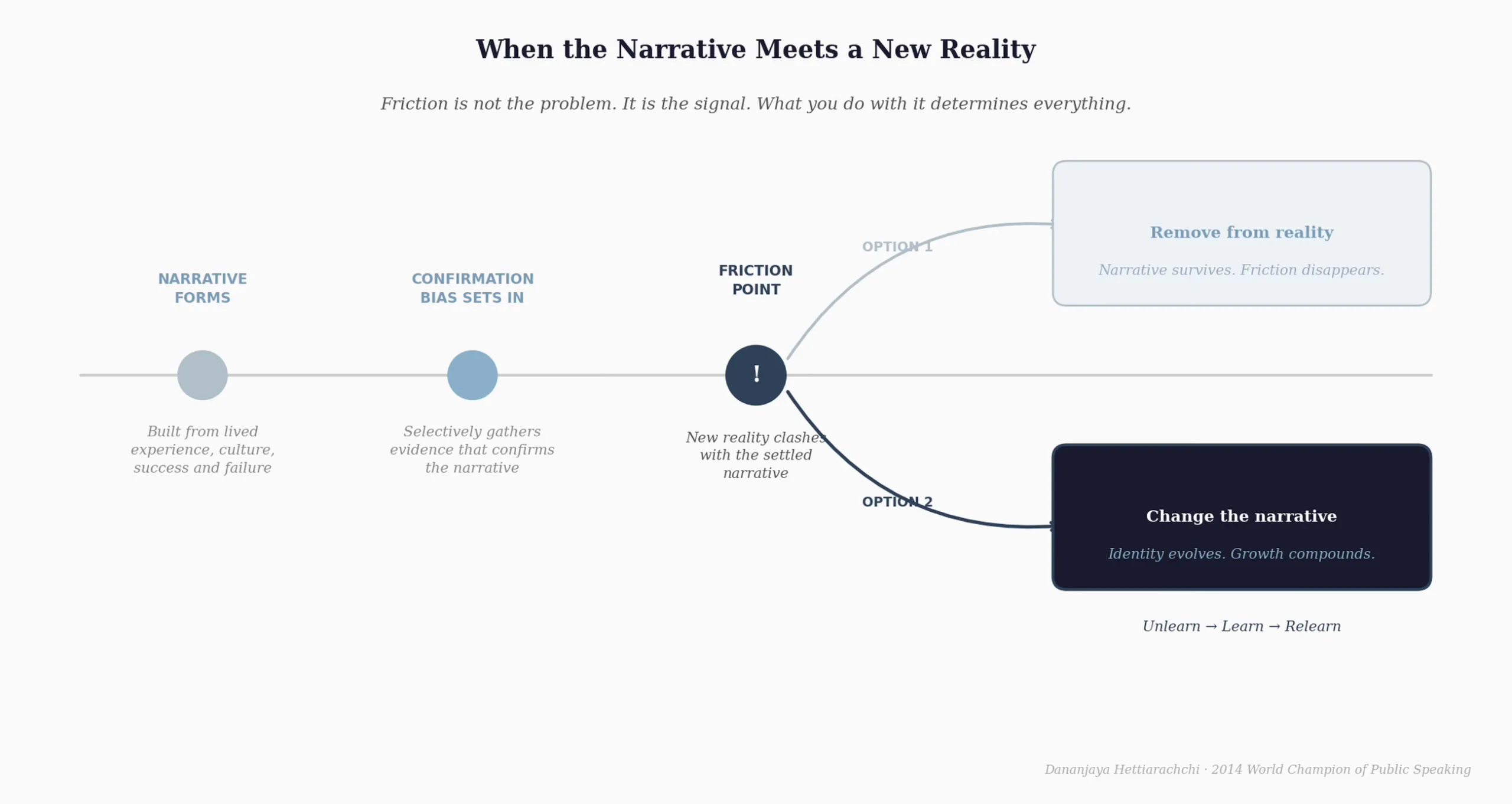
Fig. 1 — The two responses to friction. Option 1 preserves the narrative at the cost of growth. Option 2 demands the most difficult work in leadership, but it compounds.
I have sat with leaders at this exact threshold hundreds of times across five continents. And I have observed, through the sustained practice of Socratic questioning, a specific moment that I have never been able to fully predict or engineer, only create conditions for. It is the moment when the leader’s own logic walks them to the edge of their contradiction. When the questions lead not to an answer I have given them, but to an answer they cannot deny they have found themselves. At that moment, one of two things happens: an aha, a visible release, something shifting in the face and the body, the look of a person who has just seen clearly for the first time what they had been carrying, or a retreat, where the narrative closes around itself like an immune response, generating new rationalisations to protect the belief from the logic that just threatened it.
What determines which way it goes? I have wondered about this for years. I do not have a complete answer. What I know is that it cannot be forced. The crossing, from defended narrative to honest examination, is the leader’s alone to make. The coach’s work is to ask the question that cannot be deflected. The leader’s work is to stay in the discomfort long enough to hear the answer. Whether they do is, in the end, a matter of something I can only call readiness, and readiness has its own timing, independent of anyone’s schedule.
If the moment of genuine transformation cannot be engineered, only invited, what does that say about the thousands of leadership programmes that promise to deliver it on a timeline?
What Unlearning Actually Costs
The leaders who do cross that threshold consistently describe the same experience in the immediate aftermath: a nakedness. A groundlessness. The identity that organised their professional life has been questioned at its foundations, and the new one has not yet accumulated enough evidence to feel solid. It feels, one leader told me, like having a new line of code installed, you do not know if it will run until the programme is tested in a real environment.
This is not metaphor. It is an exact description of what the psychology of identity change actually feels like. The old narrative, for all its limitations, was familiar. It had been lived in. Its edges were known. The new narrative, the one that more honestly reflects who the leader is becoming, is untested, uncomfortable, and does not yet feel like home. And the temptation, in that discomfort, is to reach back for the old story. To decide that the change was premature. To find evidence that the original narrative was right after all.
This is where the confirmation bias that once maintained the old narrative becomes the most powerful tool available for building the new one. The same mechanism that spent years selecting evidence to confirm who the leader was can be consciously redirected, each small moment of leading differently becoming a data point, each time the team performs beyond what the old narrative would have allowed, becoming proof that the new story is not just aspiration but reality. The identity stabilises not through insight but through accumulation. Not through deciding to believe the new narrative, but through collecting enough lived evidence that the new narrative begins to believe in itself.
Confirmation bias built the prison. Consciously redirected, it builds freedom. The mechanism does not change. Only the story you ask it to confirm.
I worked with a leader early in his career who carried a narrative of inadequacy so deep it had produced a full imposter syndrome. The work was to replace that narrative with something truer, a story built on what he had actually demonstrated, what he had earned, what the evidence of his own life already showed about his capability. That new narrative worked. It worked so well that he rose steadily, performing at levels the old story would never have permitted.
The narrative that replaced imposter syndrome was individual excellence, and for several years, it was exactly right.
Then he was given regional teams to manage. And the individual excellence narrative, unexamined, continued to run. He solved problems himself rather than through his team. He provided answers rather than developed thinkers. He led, in essence, as if the promotion had never happened, as if he were still the individual whose performance had been the unit of value, rather than the leader whose restraint and trust was now the unit of value. The narrative that had cured his imposter syndrome had become, at this new level, the very thing limiting his teams and capping his authority.
He had to unlearn it. Not abandon it; the individual excellence it described was real and remained part of him. But unlearn the supremacy of it. Learn a new story in which his excellence expressed itself through others rather than instead of them. Relearn what it meant to be capable, in a context where capability meant making space rather than taking it.
When the narrative that saved a leader from one limitation becomes the source of the next one, who is responsible for surfacing that? The leader who cannot see it? The organisation that promoted them without preparing them? Or the coaches and mentors who were never given, or never took, the access required to see it clearly?
The leaders who cannot reach this work, who have not yet experienced enough pain to make the protection of the narrative more costly than its examination, will not do it voluntarily. This is the honest truth. The friction can be present for years without producing the readiness to examine it, as long as the removal option remains available. The role can be changed, the team restructured, the environment adjusted, and the narrative survives another cycle.
But there is a version of this story that does not end with crisis. It ends with a leader who chooses, before the pain becomes unbearable, to look at the friction with curiosity rather than defensiveness. Who finds, or builds, the relationship of trust that makes honest examination possible. Who sits with the Socratic question long enough to follow it to the edge of their own contradiction, and then, instead of retreating, stays.
What is found there, beneath the narrative, in the nakedness of the undefended self, I have witnessed it more times than I can count, and I have never stopped being moved by it. Not weakness. Not the fragility the leader feared. Something the opposite of fragile: a strength so fundamental it needed no story to protect it, no narrative to justify it, no confirmation bias to sustain it.
The armour was never the strength. It was what the leader had not yet trusted themselves to be without.
Strip away the narrative and you do not find less of a person. You find the one who was always there, unedited, unprotected, and more capable than the story ever allowed them to be.
Dananjaya Hettiarachchi is the 2014 World Champion of Public Speaking. He works with a select group of senior executives each year on executive presence, leadership communication, and authority transitions. His signature speech, ‘I See Something in You,’ has been viewed over 10 million times.